The Case for Division III
The most overlooked level in college basketball might offer the most complete college experience.

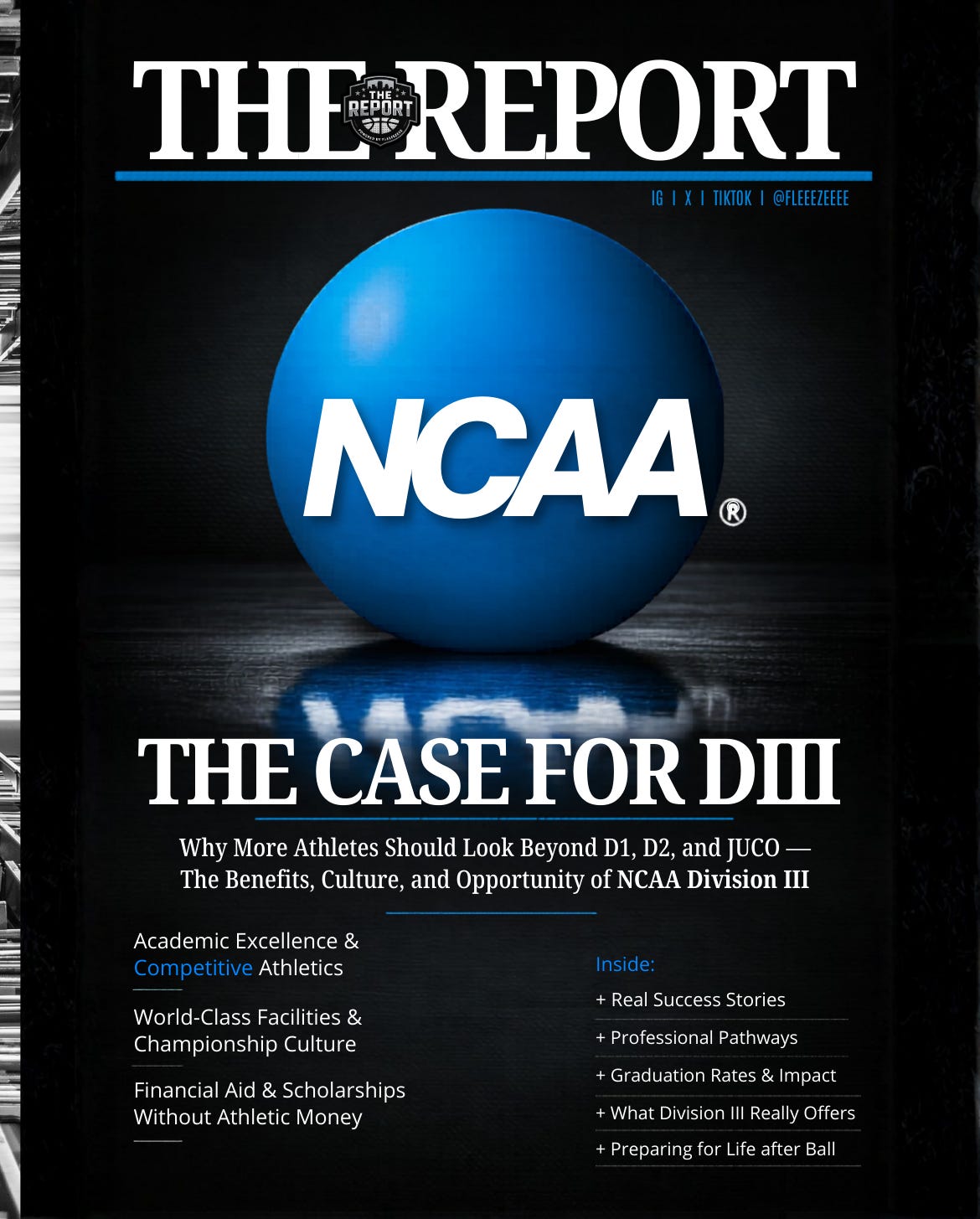
In the modern recruiting world, conversations often begin with one simple question:
“What level are you trying to play?”
Too often, that question is answered with Division II, NAIA, or JUCO — skipping over one of the most compelling opportunities in college athletics: NCAA Division III.
For many families and prospects, Division III is dismissed almost immediately. The reason is simple and widely known: Division III schools do not offer athletic scholarships. Because of that single rule, many athletes and families move on without ever giving the level a serious look.
But from a college coach’s perspective, that quick dismissal often overlooks what Division III actually offers.
In reality, Division III is the largest NCAA division, home to more than 420 colleges and universities and over 200,000 student‑athletes, representing roughly 40 % of all NCAA athletes — the most participants of any NCAA division. About 1 in 4 students on a Division III campus is also a student‑athlete, and data shows that Division III athletes graduate at a rate higher than the general student body. That scale alone makes it a level worth considering.
A Different Kind of Commitment
One of the biggest misconceptions about Division III athletics is that it represents a step down competitively. In reality, the difference isn’t always about talent — it’s often about priorities.
At the Division III level, athletes are making a conscious decision. They’re choosing to compete in college because they love the game, not because of a scholarship attached to it. That difference in motivation shapes the culture inside a program.
Walk into most Division III locker rooms and you’ll find athletes who train hard, compete fiercely, and still attend class, participate in co‑curricular activities, or even study abroad during their collegiate career. About three‑quarters of Division III athletes complete an internship or externship, and nearly half work a job while in school, demonstrating the balance these students maintain between athletics and life.
It’s not just athlete life.
It’s college life with athletics woven in.
How Division III Is Viewed in Arizona: A Local Perspective
Athletes and families in Arizona see college sports differently than in many other states. Arizona does not currently have any NCAA Division III institutions. The state’s athletic landscape jumps from NCAA Division I programs directly to NAIA and community college options.
As a result:
Most Arizona athletes grow up watching the Arizona Wildcats or Arizona State Sun Devils, and DIII is rarely part of the conversation.
Without DIII schools nearby, families often assume, “If it’s not Division I, it’s not worth considering” or that financial aid won’t be available.
Even so, exposure to DIII success stories and professional pathways is slowly changing perception. Arizona athletes increasingly see that Division III offers:
World-class facilities
Nationally competitive programs
Strong academics and financial aid
Opportunities to pursue professional sports or coaching careers
For Arizona families, Division III is becoming a more appealing and realistic option — even if it exists mostly outside the state.
Facilities and Resources Rival Many Higher Levels
Another myth about Division III athletics is that the facilities somehow lag behind other levels.
That couldn’t be further from the truth.
Many Division III schools are well-funded institutions with outstanding athletic facilities, including:
Modern performance centers and weight rooms
Dedicated practice facilities
Full-time strength and conditioning staff
Sports medicine and recovery programs
State-of-the-art arenas and stadiums
In many cases, these facilities rival or exceed those found at smaller Division I or Division II programs. Athletics is a central part of campus life, and student-athletes are highly visible, highly supported, and play a major role in the identity of the school.
For a detailed look at some of the best Division III facilities, see the Top 25 DIII Athletic Facilities list here: D3 Direct Top Facilities.
The Scholarship Misconception
The biggest reason Division III is dismissed is the belief that, without athletic scholarships, the school must be financially out of reach.
That assumption is often wrong.
While Division III programs cannot offer athletic scholarships, roughly 80 % of student-athletes receive some form of financial aid — through academic scholarships, grants, or need-based assistance. The aid may come from:
Academic merit awards
Institutional scholarships
Leadership grants
Need-based financial aid
Combined, these sources often create a package similar to a partial athletic scholarship at another level. For many prospects, this means they can continue their athletic careers without taking on significant debt, allowing them to compete at a high level while leaving college in a strong financial position.
The Competitive Reality
Another misconception is that Division III athletes don’t train or compete seriously.
In truth, Division III athletes lift, watch film, practice daily, and work relentlessly — just like athletes at any other NCAA level. Roster spots are far from guaranteed, and programs often recruit the same athletes being considered by Division II schools.
As longtime recruiting voice Dana Janssen explains:
“I disagree that anyone can play Division III. I’ve said no to more athletes in my 31 years than I’ve said yes to. Depending on the sport, program, and school, we recruit against Division II schools every year in every sport.”
A National Championship Experience
Division III athletes also compete for 28 national team championships, creating one of the most competitive postseason environments in college sports. The experience of chasing a national title while attending a strong academic institution is exactly the balance many athletes are looking for.
Famous Division III Players and Coaches Who Went Professional
While Division III is often overlooked, many DIII alumni have played professionally or gone on to high-level pro coaching careers:
Mike Brown – Played at John Carroll University (OH) and became an NBA head coach, leading teams like the Cleveland Cavaliers and Los Angeles Lakers.
Tom Thibodeau – Former DIII player at Plymouth State University (NH); became an NBA head coach, including the Chicago Bulls and New York Knicks.
Jeff Van Gundy – Played at Rensselaer Polytechnic Institute (RPI) and became a long-time NBA coach and commentator.
These examples show that Division III can be a legitimate path to professional sports, even without athletic scholarships.
Beyond the Game: Preparing for Life
Division III isn’t just a four-year decision — it’s a lifetime investment.
Student-athletes are encouraged to engage fully in the campus community. Division III athletes often report greater gains in time management, stronger campus involvement, and higher civic engagement than the general student body. The relationships, education, and experiences built during college often matter as much as what happens on the court.
Why More Families Are Looking Again — and Why Division III Matters
Families are asking better questions:
Where will I thrive academically?
Where will I be happiest?
Where will I grow the most as a person?
When those questions guide the conversation, Division III shines, offering:
High-level competition
Outstanding facilities
A passionate athletic culture
A comprehensive college experience
NCAA Division III isn’t a fallback. It’s a deliberate choice that combines competitive athletics with academic excellence, financial support, and a genuine college community. With standout facilities, championship opportunities, professional pathways, and lifelong leadership development, Division III provides a balanced, powerful path for athletes who want the full collegiate experience — on their terms.
From both a recruiting and a life-preparation perspective, Division III deserves a serious look, not as a consolation, but as one of the most rewarding divisions in college athletics.1
Great write up! Thanks for the shoutout